DIY Vacuum Cleaner
We built a vacuum cleaner the old-school way: no CAD, no simulations, just a strong fan, a plastic watering can, and a series of deliberate design trade-offs.
From Scratch to a Working Vacuum
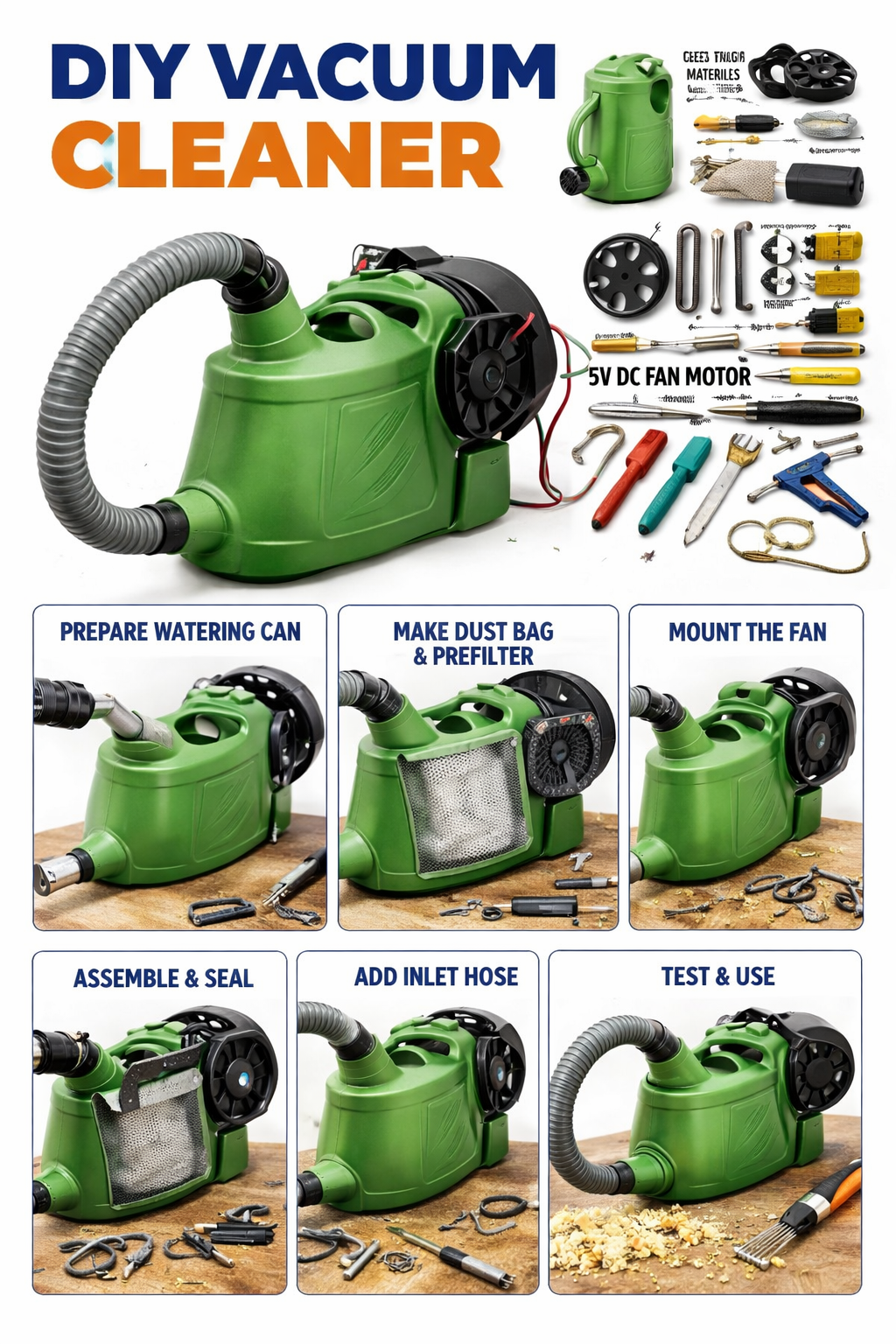
This vacuum cleaner was built the old-school way: no CAD models, no simulations, and no optimization loops on a screen. The design started with a simple constraint—a fan strong enough to generate suction—and a readily available medium: a portable plastic watering can. From there, every decision was a trade-off made by reasoning and experience. Airflow versus filtration, suction versus motor safety, simplicity versus durability. The watering can became the dust-collection chamber by assumption, not calculation; the fan placement was chosen to pull air through the can rather than push it, based on intuition about dust separation and motor protection.
From Scratch to a Working Vacuum
With the concept set, the build moved directly to physical execution. The watering can was modified to accept an inlet and hose, a basic dust bag and prefilter were added to keep debris away from the fan, and the fan was mounted to exhaust air from the can while creating suction at the inlet. Every joint was sealed, reinforced, and tested by hand, not by software. Performance was validated empirically—by feel, sound, suction strength, and motor temperature—until it behaved like a usable vacuum. The final product is not optimized or certified, but it works, and more importantly, it demonstrates how functional engineering can emerge from first principles, assumptions, and real-world iteration rather than simulations alone.
@luisenrico9