Spaghetti Bridge
January 2026
This spaghetti bridge uses a simple Warren truss with short, bundled compression members and light tension members to reliably carry heavy loads far beyond what most designs achieve.
The 50‑kg Spaghetti Bridge That Wins
This chapter distills everything that actually matters when building a competition‑grade spaghetti bridge. No tricks, no aesthetics, no unnecessary theory — just decisions that reliably let a bridge carry 50 kg and beyond.
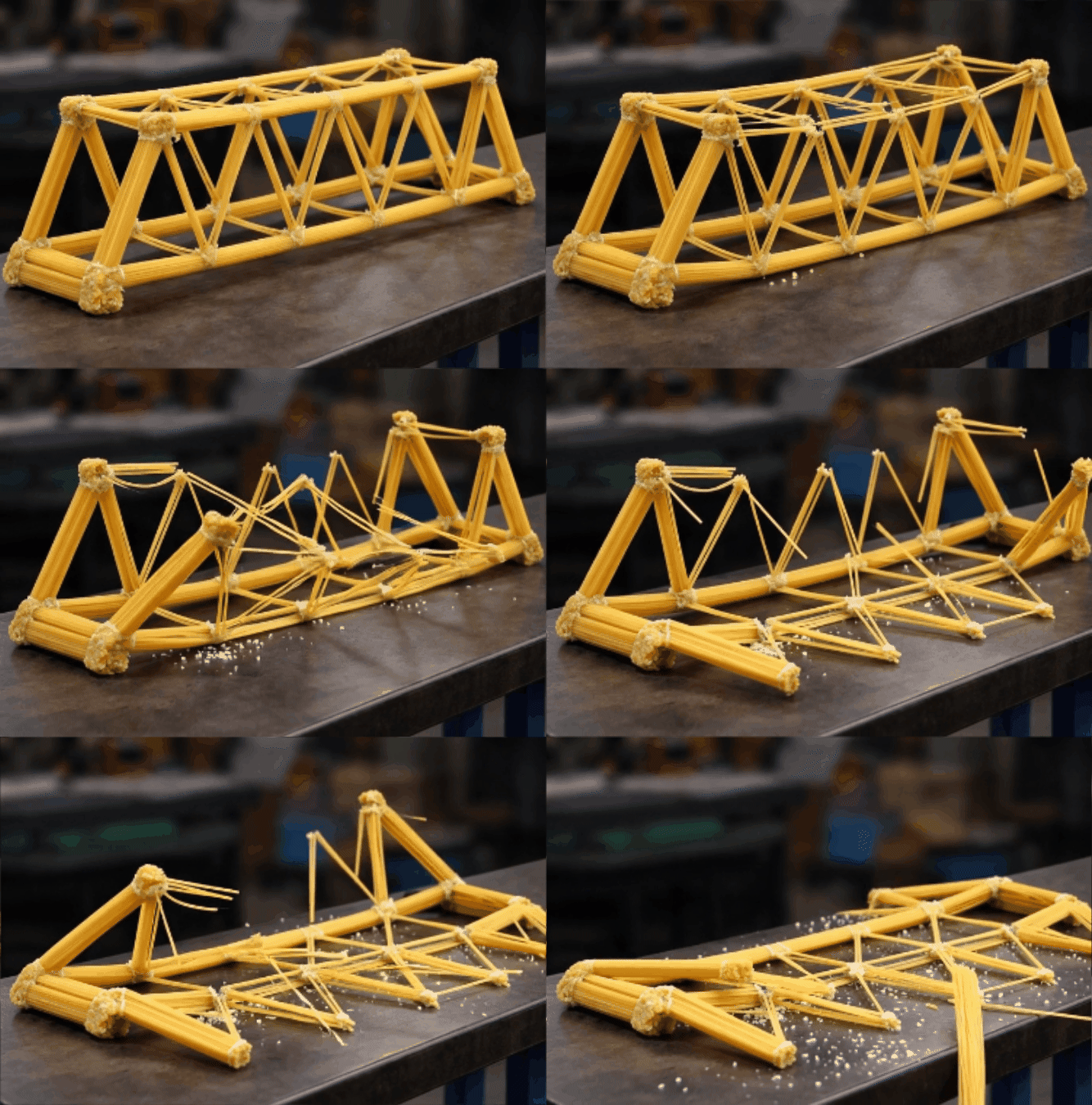
Run through on what really happens when it breaks!
A spaghetti bridge is an architectural model of a bridge, made of uncooked spaghetti or other hard, dry, straight noodles. Bridges are constructed for both educational experiments and competitions. The aim is usually to construct a bridge with a specific quantity of materials over a specific span, that can sustain a load. Using only Super Glue and Stick Glue for bonding agent.
However!
What we should do is to Intentionally create sacrificial members that fail first in non-critical locations, allowing the load to reroute without catastrophic collapse.
1. Choose on structure and commit to it!
Use a straight Warren truss with equal‑sized triangles. This geometry naturally balances forces and avoids long, weak members. Fancy shapes introduce uncertainty; repetition creates predictability. Predictability is how bridges win.
2. Treat compression as the enemy
Spaghetti fails in compression by buckling, not by crushing. Any member under compression must be short and thick. If a compression member is longer than a finger, bundle it. Bundling must be three‑dimensional — triangular or box‑like. Moving material away from the center dramatically increases buckling resistance.
3. Keep Tension members light
Spaghetti performs well in tension. Use single sticks for tension members. Bundling here wastes weight and gives no advantage. A winning bridge is heavy only where it must be.
4. Build joints like structural elements
Most bridges fail at joints, not members. Every joint must:
- Have roughened spahetti ends
- use the prescribed glue's
- Overlap members by atleast 10-15 mm
Now the non-obious trick!
The bridge is not failing at 50 kg but it's failing earlier, adn the rest is just delayed collapse. what actually happens is this:
- At 60 - 80% of max load, one compression member micro-buckles
- This causes a force distribution across the truss
- Other members quietly take overload they were never designed for
- The final "snap" is just the moment the structure runs out of redundancy, not strength
Behind the scenes
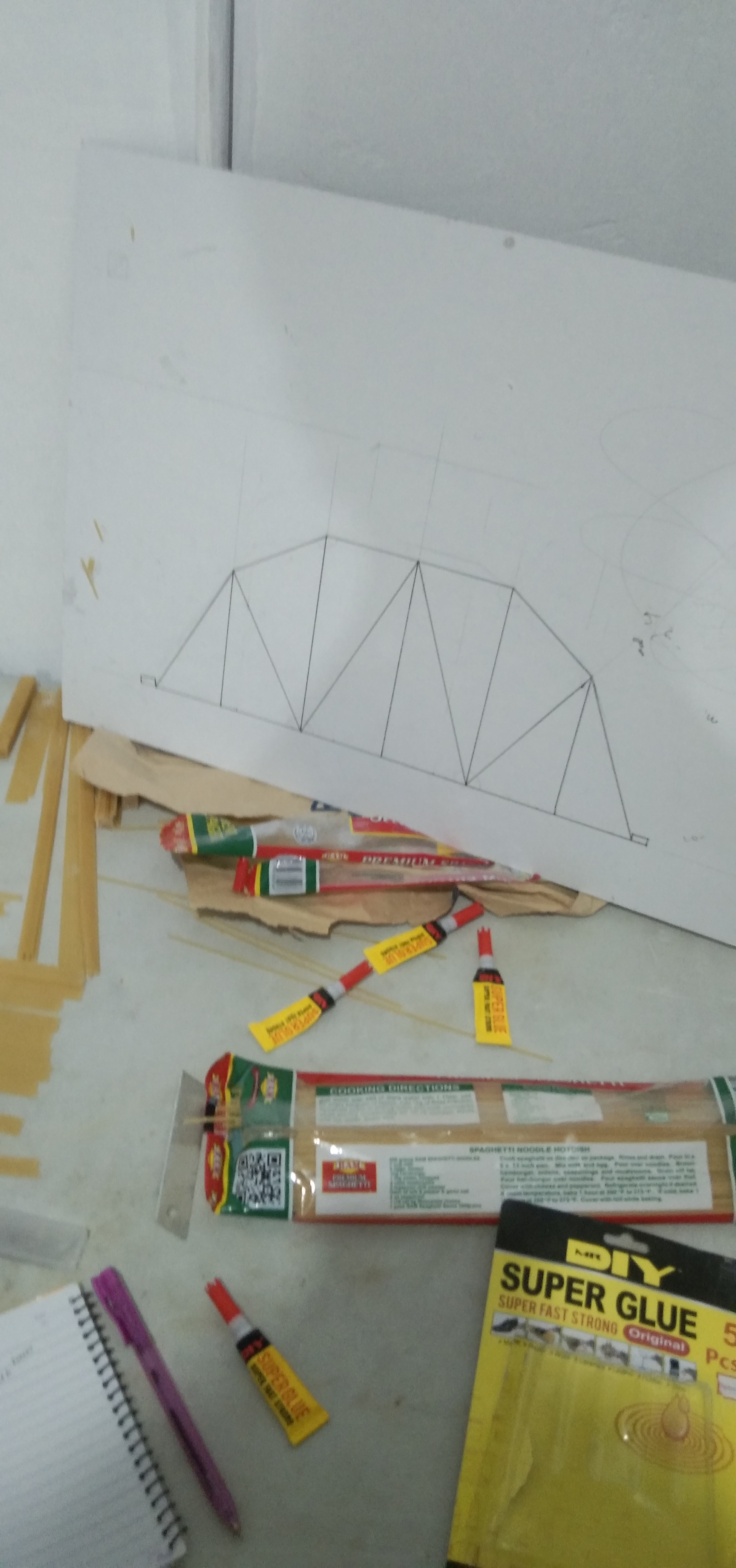
We did a 1:1 scale blueprint for our bridge

You need to follow the constraints and weight limit! Optimize how many sticks per parts volume!
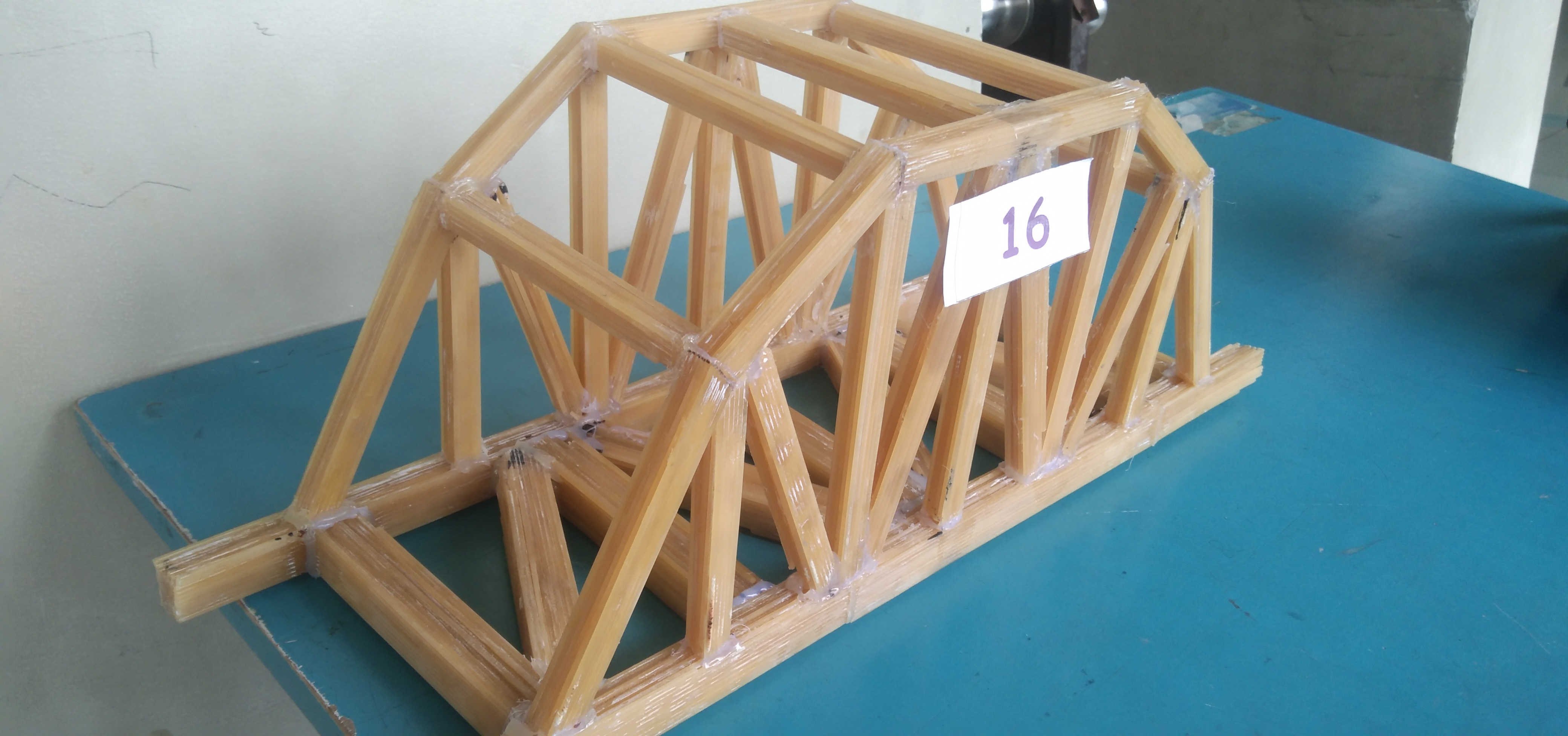
The finish product! It looks messy but we are proud of this :)
Then the actual weighing in!
That is all Folks! Happy building! :D