Spaghetti Tower
You don’t win by making spaghetti stronger; you win by designing geometry that forces the load to flow straight down through short, well-braced paths so spaghetti never gets the chance to buckle.
Head's up
A spaghetti tower that carries 100 kg works only because the structure prevents spaghetti from ever doing what it’s bad at. Spaghetti is not weak in the sense people think; it fails because it buckles long before it breaks. The entire design problem is therefore about stopping buckling, not about increasing material strength.
The fastest way to lose is to think in terms of “tower” or “pillar.” The moment you imagine a vertical column carrying weight, you’ve already lost, because columns invite buckling. Winning teams don’t design towers; they design load paths. The structure is just a scaffold that forces the load to flow where you want it to go.
Load Paths and Failure Intuition (Why It Actually Works)
There are only two intuition, first is this: height is fake. Externally the structure may be tall, but internally nothing is long. Every compression member is brutally short, interrupted by triangles before it ever gets the chance to bend. If you see a member longer than a few centimeters carrying compression, it’s a ticking clock
Joints are where most towers actually fail. If joints are brittle or poorly bonded, the structure collapses long before the spaghetti reaches its theoretical limits. Good joints spread load gradually from one member to another. Slight compliance in the glue is beneficial because it allows stress redistribution instead of concentrating forces at a single point. A well-designed joint is stronger than the members it connects.
So in summary,:
- Compression is guilty until proven innocent
- Geometry beats optimization
- Joints are structural members
- Symmetry is not aesthetics, it's insurance
CAD, Simulation, and Behind the Scenes (What You See)
Spaghetti pasta is known for its smooth, thin, and brittle strips which snap in half with
the slightest bit of stresses induced by loads applied to it. While creating a tower using this may
be difficult, applying the right design and analysis creates an effective and efficient tower.
For the tower to hold up to 100 kg, Royal Pasta spaghetti was used for the tower
construction. The bundle of the spaghetti strands that these members are
made of is coupled and locked together by bathing it superglue, which creates a composite
material having strength exponentially higher than its individual parts,
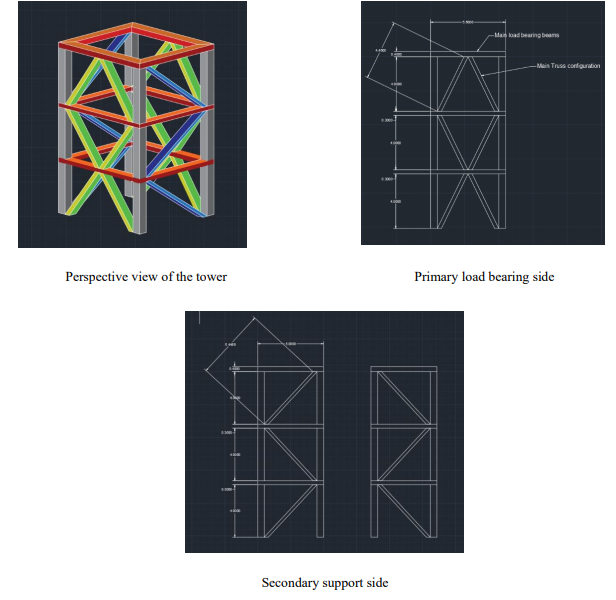
Each member of the tower, are made with materials that are proportional to loads they
carry. Since the load are to be subjected on the top of the tower, the forces involved are mostly
vertical and compressive. In such, the columns are made 5x5 strands of spaghetti as they bear
most the compressive forces of the 10 kilogram load. The main beams on the top, in which the
jig sits on are made with 4x4 strands of spaghetti. The trusses are and the rest of the beams are
made with 3x2 strands of spaghetti